

Last Updated: October 25, 2026
Quick Summary
Natural scents fade faster because they are built from volatile plant compounds that evaporate quickly once they meet air, body heat, and skin. Synthetic fragrance molecules are often larger and more stable, so they hold their shape longer. Natural blends also often lack heavy fixatives like resins and woods that slow evaporation.
- Citrus oils vanish in minutes, while resins and woods linger for hours.
- Dry skin releases fragrance faster than oily skin, so natural scents fade quickest there.
- Apply fragrance to moisturized pulse points and never rub it in, which speeds fading.
- Test wear time by spraying one wrist and checking every hour on a controlled day.
- Store bottles in a cool, dark place with the cap tight, away from sun and radiators.
Table of Contents
- The Real Reason Natural Scents Fade Faster
- Natural vs Synthetic Fragrance: What Actually Lasts Longer
- Fragrance Notes That Last Longest (and Which Fade First)
- How Skin Type and Application Affect Natural Fragrance Longevity
- How to Make Fragrance Last Longer: A Step-by-Step Routine
- Fading or Nose Blindness? How to Tell the Difference
- Storing Natural Scents So They Keep Their Strength
- Choosing a Natural Scent That Fits Your Wear-Time Needs
- Frequently Asked Questions
The Real Reason Natural Scents Fade Faster
Natural scents fade faster because they are built from volatile plant compounds that evaporate quickly once they meet air, body heat, and skin. Synthetic fragrance molecules are often larger and more stable, so they hold their shape longer. At Blithe and Bonny, we work with both essential oils and phthalate-free fragrance oils, and we explain the trade-off honestly: natural materials smell alive, but they ask more of you.
Here is the part most guides skip. "Natural" is not one ingredient. It is a crowd of them, each with its own evaporation rate. Citrus oils vanish in minutes. Resins and woods linger for hours. A natural blend is only as strong as its most fragile note.
Below, we break down why natural scents fade, which notes outlast the rest, and a simple routine that adds real wear time.
Natural vs Synthetic Fragrance: What Actually Lasts Longer
Synthetic fragrance generally lasts longer on skin than natural fragrance, but the gap is smaller and more conditional than most guides admit.
Natural fragrance is built from essential oils, absolutes, and plant extracts. These are complex mixtures of volatile compounds. Limonene, the dominant molecule in citrus peel oil, has a low molecular weight and a high vapor pressure, so it lifts off skin within minutes.
Synthetic fragrance uses lab-built molecules. Many are heavier (larger molecular weight) and more resistant to breakdown from heat, light, and oxygen.
The FDA guidance on cosmetics and fragrance labeling draws the same line regulators use: "fragrance" covers both plant-derived and lab-made materials. Neither is automatically safer, and neither is automatically longer-lasting.
Why Natural Materials Can Fade Faster
Four forces work against natural scents, and each has a concrete mechanism:
- Small molecules leave first. Citrus and light floral compounds are tiny and evaporate quickly. Limonene, for example, is a 10-carbon monoterpene with a boiling point around 176°C (349°F), low enough that body heat alone accelerates its escape.
- Oxidation. Oxygen breaks down delicate plant molecules. Linalool and limonene oxidize into less fragrant byproducts (and, in some people, skin sensitizers), so the scent dulls rather than simply disappearing.
- No heavy anchors. Natural blends often lack the large, slow molecules that act as fixatives. A fixative is a material with low volatility that slows the evaporation of lighter molecules around it, natural options include resins (benzoin, labdanum), woods (sandalwood, vetiver), and some absolutes. When a formula skips them, the top notes leave unopposed.
- Skin chemistry and pH. Natural materials can react with skin pH and enzymes, shifting the scent profile and sometimes speeding breakdown. This is why the same oil can smell different, and last differently, on two people.
A common mistake is assuming "natural" means "gentle on the nose but weak on skin." Not quite. It means the formula needs more help staying put, either through fixatives, concentration, or application technique.
Fragrance Notes That Last Longest (and Which Fade First)
Woody, resinous, and musky base notes last longest, while citrus and light green notes fade first. This is the single most useful thing to know when you shop.
Think of a fragrance in three layers:
| Note Layer | Typical Examples | Fade Speed |
|---|---|---|
| Top notes | Citrus, bergamot, grapefruit | Minutes |
| Middle notes | Rose, jasmine, lavender | 1-3 hours |
| Base notes | Vetiver, sandalwood, palo santo | 4+ hours |
If you love a bright grapefruit scent, expect to reapply. If you want staying power, lean toward vetiver fern, rose, or palo santo blends. Our Petite Perfume in palo santo and rose pairs a soft top with a slow base for exactly this reason.

How Skin Type and Application Affect Natural Fragrance Longevity
Dry skin releases fragrance faster than oily skin, so natural scents fade quickest on dry, flaky skin. Oil gives scent molecules something to cling to. Moisture-poor skin lets them go.
Skin chemistry matters too. A scent can smell different on you than on a friend, and it can fade at a different speed.
Application changes the math:
- Pulse points stay warmer, so scent projects more but fades sooner.
- Hair and clothing hold scent longer than bare skin.
- Moisturized skin slows evaporation.
A practical fix: layer a Body Oil under your fragrance. The oils give the scent a base to grip, and the skin stays softer.
How to Make Fragrance Last Longer: A Step-by-Step Routine
You can stretch a natural scent by prepping skin, layering products, and reapplying smartly, but the difference between a routine that works and one that just feels productive is measurement. Here is the sequence we recommend, followed by a simple test that tells you whether it is actually working.
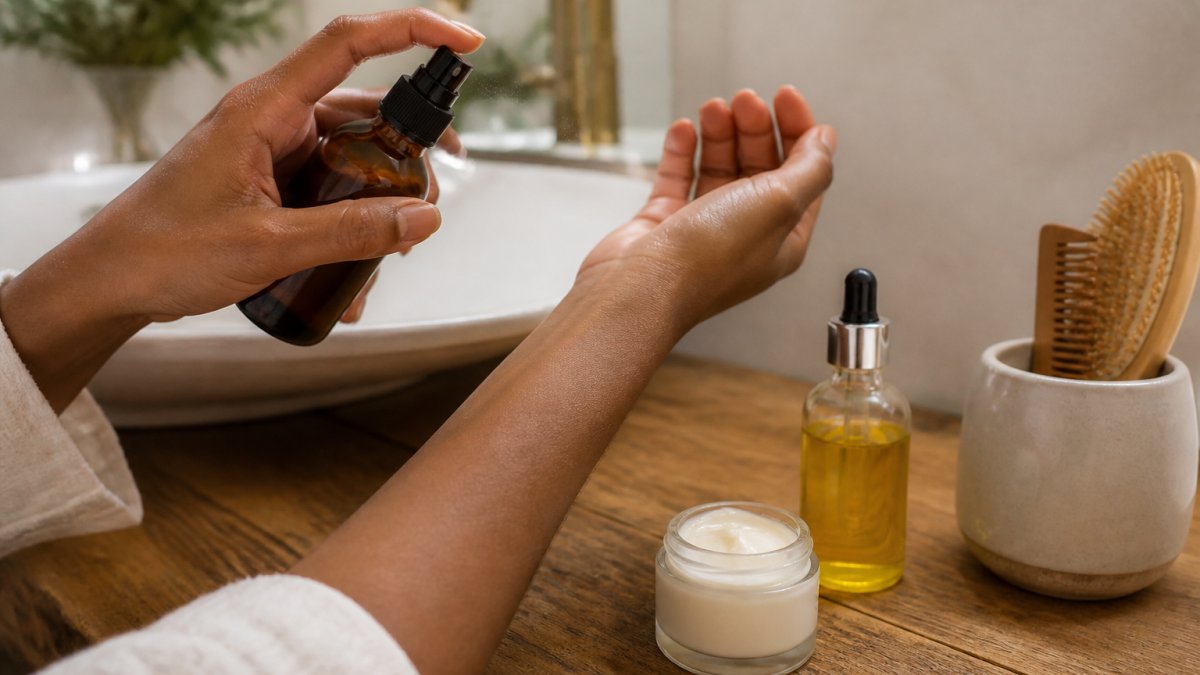
- Shower and pat dry. Leave skin slightly damp. Fragrance clings to moisture, and damp skin slows the initial evaporation burst.
- Moisturize first. Apply a Hand Cream or body oil to pulse points and let it soak in for a minute. Oils and emollients give scent molecules something to grip, especially on dry skin.
- Spray while skin is still hydrated. Apply to moisturized pulse points rather than bone-dry skin. The same fragrance can last noticeably longer on prepped skin.
- Target pulse points and hair. Wrists, neck, behind the ears, and a light mist through hair. Hair and clothing hold scent longer than bare skin because they release it more slowly.
- Do not rub. Rubbing breaks the scent molecules and speeds fading by warming the skin and dispersing the top notes.
- Reapply mid-day, but strategically. Reapply to clothing or hair rather than layering more on skin, which can overwhelm the base notes. A travel-size bottle keeps you fresh without over-spraying.
Test Your Wear Time Before You Commit
Before you buy a full bottle, run a simple, repeatable test. This is the step most guides skip, and it is the one that turns guesswork into a decision.

- Pick a controlled day. Avoid extreme heat, heavy exercise, or a long shower right after application.
- Spray one wrist (or one test strip) at a known time. Note the time and the amount, one spray, two sprays.
- Check every hour. Smell the spot and record what you detect: full strength, noticeable, faint, gone. Note whether you smell top, middle, or base notes.
- Log the environment. Note temperature, humidity, and whether you were indoors or outdoors. Heat and humidity change evaporation rates.
- Repeat with two or three scents on different days, using the same skin prep and the same number of sprays.
Write down when each scent fades to a whisper. That number is your real wear time, and comparing two or three scents this way teaches you which notes and formulas suit your skin. You will stop guessing and start choosing bottles that match how long you actually need a scent to last.
Fading or Nose Blindness? How to Tell the Difference
If a scent seems to vanish but others still notice it, you are likely nose blind, not wearing a weak fragrance. Olfactory adaptation is the brain tuning out a constant smell. It is not the same as fading.
How to tell them apart:
- Fading: the scent is gone for everyone, and reapplying helps.
- Nose blindness: you stop noticing it, but people around you still do.
A quick check: spray a fresh test strip and smell it. If the strip reads clearly, your nose adapted to the skin scent. Step outside for fresh air, then smell your wrist again.
Storing Natural Scents So They Keep Their Strength
Heat, light, and oxygen are the enemies of a natural scent. Store bottles in a cool, dark place with the cap tight. A bathroom shelf near a steamy shower is the worst spot.
Keep these habits:
- Store away from direct sun and radiators.
- Close the cap fully after each use.
- Keep the bottle in its box if you have one.
- Use within the freshness window on the label.
Amber glass, like the bottles we use for our perfumes, blocks light and helps the formula stay stable. Good packaging is not just pretty. It protects the scent.
Choosing a Natural Scent That Fits Your Wear-Time Needs
Match the scent to how long you need it to last, and you will be happier with the bottle. For a quick errand, a bright citrus is perfect.
A few questions to ask before you buy:
- How long do you need it to last? A few hours or all day?
- What notes anchor the blend? Look for vetiver, rose, sandalwood, or palo santo.
- Can you layer it? A matching body oil or cream extends wear.
- What size fits your use? The Grand Perfume gives you more sprays for daily wear.
We make small-batch scents with both essential oils and phthalate-free fragrance oils, so you can choose the strength and character you want. If you are deciding between sizes or strengths, view the larger option before you commit.

Natural scents will always ask a little more of you than synthetics. That is the honest trade for materials that smell like real plants, not a lab.
At Blithe and Bonny, we handcraft our perfumes, body oils, and creams in small batches with high-quality ingredients and sustainable packaging. Layer a scent over a moisturizer, store it cool and dark, and test your wear time before you buy.
Frequently Asked Questions
Do natural fragrances fade faster than synthetic fragrances?
Often, yes. Many natural materials are built from volatile compounds like citrus terpenes that evaporate quickly, so natural fragrance longevity tends to run shorter than synthetic formulas built around long-chain musk molecules. That does not mean natural scents are weak across the board. Resins, woods, and fixative-rich materials hold well. The fade rate depends on which materials are in the blend, how concentrated it is, and how it is applied.
Which fragrance notes fade the fastest?
Citrus notes (bergamot, grapefruit, lemon), light florals, and green or aquatic notes are the first to go, usually within 30 to 60 minutes. These are the top notes, made of small, fast-evaporating molecules. Middle notes like rose, jasmine, and lavender last a few hours. Base notes such as sandalwood, vetiver, palo santo, and resin fade slowest and can hold for six hours or more. Layering a citrus top note over a woody base gives you both brightness and staying power.
How can you make a natural scent last longer?
Start with moisturized skin: dry skin absorbs and releases scent faster, so apply an unscented or lightly scented lotion first. Spray onto pulse points and let it dry without rubbing. A light mist on hair or clothing holds longer than skin alone. Store bottles away from heat and sunlight to slow oxidation. Reapply midday rather than over-applying at the start. Pairing a body oil or hand cream in a matching or complementary scent also extends how long the fragrance reads on skin.
Does the way you store fragrance affect how long it lasts?
Yes. Heat, light, and oxygen speed up oxidation, which dulls a fragrance and shortens its useful life. Keep bottles in a cool, dark place, tightly capped, away from bathroom windowsills and radiators. Amber glass, like the bottles used for small-batch perfumes, blocks UV light and helps protect the formula. A well-stored fragrance can stay true for years; a poorly stored one can turn within months.
